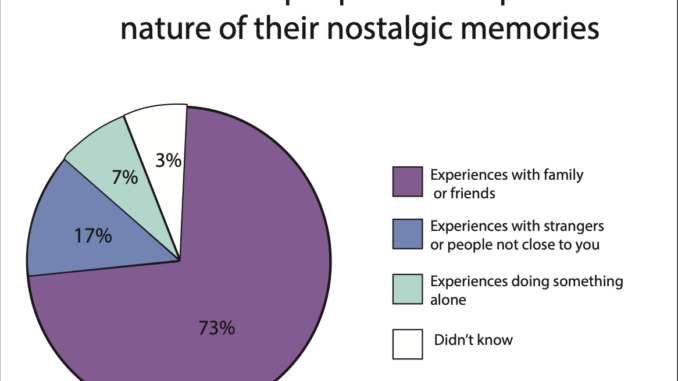
Designer: Taylor Guzek
Remember the layout of your old house? Or the class where you and your friends laughed more than you actually learned? People don’t realize that they are making memories until they are all they have left to remember. Nostalgia is a feeling that is deep and emotional, taking individuals back to their most special memories.
“Nostalgia can be defined as ‘the yearning or desire for the past,’ according to Psychology Teacher Brooke Sandy,”
The past is the place where people hoard their best and worst memories, and nostalgia allows humans to remember those moments.
“Oftentimes, we feel nostalgic or find ourselves escaping through nostalgia. It’s often because we are stressed or lonely or things just feel like a lot, and nostalgia feels like a safe place to land. It’s a comfort,” Sandy said.
Acting as a form of escape and comfort, nostalgia can be a healthy experience for so many individuals. It can serve as an emotional anchor and escape to different times.
“Dopamine is our reward neurotransmitter, and it stimulates the reward center of our brain. So when we then go to nostalgic places or engage in activities that provide nostalgia, what dopamine signals the brain is that we find it rewarding,” Sandy said.
The release of dopamine in the brain is a healthy biological process in the human body that can begin from feeling nostalgia. After experiencing nostalgia and dopamine has been released, it tells one’s brain that they like this feeling. This feeling may influence people to seek it out more.
“Just given how heavy and difficult things feel for a lot of us working parents that have aging parents, but young kids that we have to care for in different respects, nostalgia is something we utilize regularly when we need a moment to not feel the weight of that,” Sandy said.
Nostalgia can affect people of differing ages, but adults frequently experience it because they have created more memories throughout their lives than younger individuals have. Understanding what truly causes adults to remember specific events and experiences from the past requires finding common characteristics between those memories.
“Sometimes, certain smells, music or places will take me back to my childhood, like my mom’s cooking or an old playground,” 2026 graduate Max Rojas said.
Many things can lead people to feel nostalgia, and these things are all around. Things like specific scents, foods, places, music or even people can give humans a sense of nostalgia.
“Graduating soon and coming back for alumni nights and homecoming will definitely be nostalgic,” Rojas said.
As people grow older, they make new friendships, experiences and memories that they will look back on in the future. These memories resemble the way people perceive their pasts and how they long to return to it.
“A temporary reprieve or escape is fine, but if we are using it to escape into nostalgia all the time and to not deal with issues that are in front of us, like if we are using it solely as escapism and we are using it as avoidance, that is where it is not helpful,” Sandy said.
Nostalgia can be a healthy feeling, but when overused, it can have dulling effects on humans. People may become addicted to nostalgic memories, which may cause them to escape from reality more often and create distractions.
“If it’s a good song, I’ll be happy I remembered it, but sometimes there will be more unfortunate memories that come up,” Rojas said.
Even though remembering the good memories may warm the heart, remembering the bad may scar it just as much. Nostalgia can be beneficial when remembering heartfelt memories, but can remind people of the haunting ones.
“Nostalgia can be healthy, even with bad memories because it shows how far you’ve come and persevered,” Rojas said.
Using nostalgia as a temporary escape from reality is a healthy experience. However, abusing this experience may cause far more serious consequences. Remembering nostalgic experiences can allow people to remember all the hardships and struggles they’ve faced, and how they’ve become the people they are today. The past never truly leaves. Instead, it waits for the right moment to return.
Nostalgia always finds its way back to people, whether one uses it to cope, escape or romanticize the past. Today, this bittersweet longing does more than comfort the mind, it affects the way people perceive media and television.
The soothing, familiar theme song fills the living room, while I sit on the floor with a bowl of cereal, and the sounds of energetic music and aesthetics of bright colors fill the screen. For a moment, the world outside doesn’t exist; there is only the glow of the TV and the excitement of a new episode to watch.
For many people, nostalgia for certain times and childhood memories is evoked highly through media. Whether it’s negative or positive, it’s likely many people have experienced nostalgia for a different time through watching shows and movies.
“Childhood movies and TV shows evoke nostalgia because they act like time capsules. The sights, sounds, characters and storylines immediately reconnect people to moments when they were learning about the world and forming their identities,” Ohio University Professor for Psychology Keith Markman said.
It’s incredibly common for people to become sappy over childhood TV. As a kid, one is still developing and shaping who they are, and the shows and TV they watch are a huge part of that. This ultimately transports a person back to those times when they watch it.
“When contemporary shows and films are set in the 1980s or 2000s, they intentionally recreate the cultural textures of those decades. Things like fashion, technology, popular music and even the way people talk make it easy for viewers who lived through those times to be transported back,” Markman said.
This nostalgia goes the same for all generations, so shows like “Stranger Things” and “That ‘90s Show” can evoke nostalgia for adults who experienced childhood in those decades.
“Older and childhood TV creates a strong visual reminder of your childhood and strong pleasant memories from watching the show. It leverages familiar aesthetics and retro vibes,” senior Layla Pfaff said.
TV shows that people watched when they were younger create not only an emotional reminder but also the visuals remind people of a simpler time. The retro aesthetic, such as VHS tapes, neon aesthetics or specific fashion can evoke a special place in the childhood memory.
“It gives them reminders of things only from that time that they might’ve forgotten about and paints their childhoods in a positive or interesting light,” Pfaff said.
These fragments of media do more than just make people smile. They serve as a mental escape, helping people to navigate their adulthood and unlocking memories they might have forgotten about.
“At the same time, nostalgic media can have downsides if it encourages excessive rumination or avoidance. I’ve noticed that leaning too hard on the past can make present problems feel harder to address, or it can set up unrealistic comparisons that leave one feeling dissatisfied with their current life,” Markman said.
While it is a benefit to feel sappy towards the past through media, it’s easy to rely on it. Media from people’s childhood or adolescence can create delusion and too much reminiscing, making people too afraid of change. It can comfort people in many ways but also create avoidance.
“In some cases, idealizing earlier times can also deepen sadness or regret rather than offering genuine comfort,” Markman said.
According to the National Institutes of Health, nostalgia can negatively affect mental health by triggering excessive rumination, sadness and anxiety, rather than comfort. Because of these cons, it causes people to be more prone to these symptoms if they romanticize TV from their childhood.
“I love ‘My Little Pony’, and it’s a show I’ve watched during my childhood and now as a teenager. I have a special connection with it, and I have so much love for the series,” Pfaff said.
As people grow, they tend to still watch shows from their childhood. Although there are negative aspects to it, it’s also important to have that connection with one’s childhood. Everyone is different in how they consume childhood media, and everyone is different in how they process nostalgic emotions.
“From my perspective, seeing authentic details that match your own memories sparks a stream of recollections about friends, family and everyday life from that era, so the experience becomes less about the story on screen and more about reliving your own past,” Markman said.
Nostalgia surrounds daily life. Specific details from a childhood TV show not only triggers that warm and sappy sensation, but it also brings back an entire era of memories. These retro aesthetics and happy feelings from the media do not just live in the past, they actively shape today’s fashion and trends.
Low-rise vs. high-rise, baggy vs. skinny jeans, baby-tees vs. oversized t-shirts, patterns vs. plain, layered clothing vs. simple, baby boo vs. renegade, modern day and old: nostalgic trends can go head-to-head.
Each year there are a select group of popular new trends, but this year some nostalgic, old trends are making their comeback.
A bunch of old fashion trends from earlier years like the 80s, 90s, even some from 2016 are making a mark in modern day outfits. A lot of people are loving the blast from the past, looking back at nostalgic outfits people would put together and finding something one would like themselves.
“I honestly love the fact that old trends are starting to come back, especially in style and in clothing. Vintage styles are so pretty, and bringing them back after an era where everyone was wearing such modern and plain non-colorful clothing was such a good idea,” senior Claire Ohde said.
Nostalgia for the past is not always a positive feeling, some people believe trends should stay in the past; some trends including skinny jeans or bright neon colors getting paired together are not for everyone. As of right now, baggy jeans and neutral colors are a popular style.
“Skinny jeans are my least favorite. They are not comfortable at all and don’t look good. Baggy jeans are more comfortable to wear,” senior Madelyn Patton said.
Some trends coming back are people using clothes to express themselves. For example, teens are using the way they dress to represent themselves, and how they feel rather than dressing to what’s trending.
“Personally, my favorite trend that is coming back is expressive clothing. Honestly, it is such a good way to show personality through your outfits with fun prints, colors and even things that look like they don’t belong together, but they actually do. Style is such a great way to show personal expression and be confident in yourself,” Ohde said.
Not only is dressing up and finding new trends fun for girls, but also guys. Baggy denim, long sleeves under T-shirts, baggy jeans, quarter zips and other old school fits are making its way into 2026. These old clothing trends are romanticized by Gen Z, making them romanticize a retro time.
“My favorite trend that has come back is probably old money outfits like quarter zips and things like that,” senior Jack Wier said.
A popular way people are finding new outfits or trends from the past is thrifting. Going to a store and buying vintage clothes or even looking through parents’ old stuff is a great way to find something one might like. This evokes nostalgic feelings to peoples families fashion taste and lifestyle, making that feeling more personal for them.
“Old trends are coming back because people see or hear things their parents or grandparents may have had that they want to try for themselves or they think the older styles are cute,” senior Claire Ditty said.
These trends bring a sense of nostalgia back into all generations’ lives. Parents and grandparents get to take a trip back and enjoy seeing items from their childhoods or early adulthoods.
“What I like about old trends coming back is that it’s also encouraging people to do research back to when that style was especially hot and learn more about why the style was so popular and how people lived in that time,” Ohde said.
Clothing and styles are a big part of trends these days, but people can’t forget about the jokes, music and dances that make a nostalgic impact. 2020 was a great year for many trends when TikTok was the main resource for new trends like fun dances like the Renegade, making slime, baking homemade sourdough and making Tiktok transitions.
“Honestly, I hope the cringy TikTok era of 2020 never comes back. The digital footprint that so many people left is diabolical, especially the POV creators. Some of them are still taking consequences and slander for what they posted in 2020,” senior Danielle Drayer said.
Humor plays a huge role in people’s lives back then and now. Drayer said old trends “last longer” rather than trends now. The joke of “dabbing on the haters” holds so much nostalgia that the joke stuck for a long time, but now jokes like “six-seven”, “you the birthday” memes, baby-booing or scubaing and even using random pictures to comment on posts only stick for a few months before people move onto something new and forget about them.
“I would say there are good and bad in both, but overall I would have to say stylistically old trends. However, humor wise, new trends are better for sure because old humor dies quick and becomes no longer funny in the future,” Wier said.
People seem to love this walk down memory lane, exploring the popular and unpopular trends from the past. Hopefully, these nostalgic trends stick for a while before society moves on to the next because these throwbacks are something fun for future generations to enjoy and revisit.
People love to reminisce as they grow up, and that’s exactly what nostalgia is for a lot of people, thinking and reminiscing about trends and memories from their childhood, especially the 2026 graduates, who are stepping into a new era of life.
Many graduates start to realize that high school was more than just classes, homework and tests. It was Friday night football games, inside jokes with friends, homecoming, favorite teachers and moments that turned into memories without them realizing. At the same time, teachers, who once sat at those same desks, look back on their high school years.
By comparing what recent graduates say they will miss most and what teachers remember most, it becomes clear that times change and people grow, but the experience of high school has left its mark on everyone.
“I’m going to miss all the activities the most because I’ve been in many of them for more than three years, meeting everyone, creating memories and enjoying the communities,” 2026 graduate Vivian Chen said.
For today’s seniors, nostalgia isn’t about the big events like prom or graduation; it’s about the many small everyday moments they share with the people they love: sitting with friends laughing over small, silly things that are forgotten by tomorrow. Moments like these sneak up on people later, turning into memories one wishes they could relive.
“I’ll miss the ability to see my friends every day and to be in an environment where everyone is fostering a community in such close quarters,” 2026 graduate Abi Wykoff said.
While many graduates like Wykoff reflected on the friendships and daily moments they are about to leave behind, teachers experience the same sense of nostalgia from a different perspective. While students come and go each year, the teachers remain.
The teachers watch their students grow, not realizing they are raising the next generation of leaders. For some, those memories are even more personal, as they now teach in the same halls they once walked as students.
“I feel like there are so many things that bring nostalgia. Football Friday nights for sure always does. I was in the marching band, so every time you are in that environment, it’s very nostalgic. But I was definitely an early 2000s punk girl, so any time I hear any of that music it’s very nostalgic of singing in the car with my friends, like Paramour and stuff like that,” English Teacher Elizabeth Stringer said.
When thinking about all the different graduating years, there are so many things that are unique to every one of them but arguably the most obvious ones are the trends. Trends come and go throughout the years, and some make their comebacks while some disappear within a year.
“I can definitely see Y2K coming back in the future. I don’t think Visco girls are coming back anytime soon. The jorts are coming back. I remember jorts used to be pretty popular, and then they fell off, and now they are coming back. I actually got a pair of my own jorts a couple of weeks ago so I’ve been wearing those a lot,” 2026 graduate Sam Hardjono said.
Today’s teachers have seen many trends continue to evolve and come back throughout their careers. However, some trends the teachers lived through have made their comeback today through students. Many of these trends bring teachers back to their high school experience.
“The trend I’ve seen come back is music from the 80s. Kids today like 80s music and they talk to me about it being ‘vintage’ and they know songs that they will listen to here and that’s like my high school,” English Teacher Kelly Cable said.
High school isn’t only about academics. It’s really about the memories that are built within the friendships, the challenges and the growth.
Nostalgia reminds both recent graduates and teachers that while time continues to move forward and relationships come and go, those memories made won’t disappear. They continue to stay and shape who students are, reminding them that high school was more than just the tests and homework. And maybe that’s what makes time so valuable, knowing that it won’t last forever.



Be the first to comment