photo credit: Grant Ruof
Think of all the trends that have been dangerous throughout the years: the one chip challenge and the Tide pod challenge. However, they mostly end fast. But one trend that has stayed consistent is energy drinks. By just walking in the hallways at school, anyone can see dozens and dozens of students drinking energy drinks every single day.
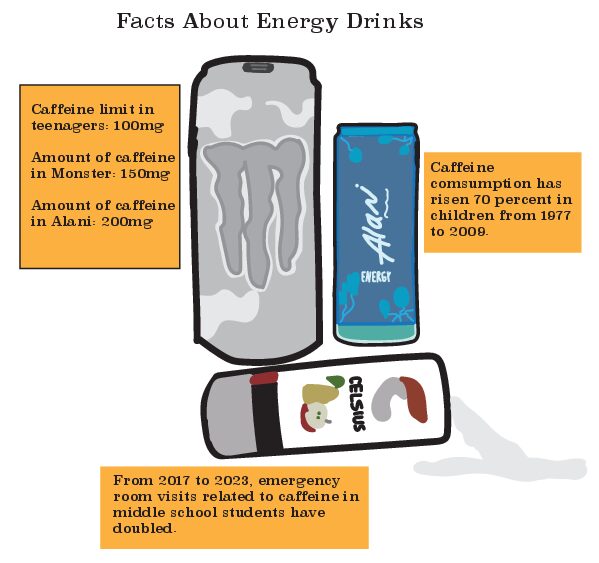
This fad can have detrimental effects to those consuming energy drinks consistently. For example, according to Mayo Clinic, around 400 milligrams of caffeine per day seems safe for adults. The energy drink Alani, which is a popular drink for teenagers, contains 200 milligrams of caffeine in each drink. These cans are mainly 12 ounces of actual liquid. That’s less than what is typically in a water bottle.
According to the National Institute of Health, the rise of the energy drink market has caused a 70 percent increase of caffeine consumption in children from 1977 to 2009. This is a huge change to society and has raised concerns for teenagers.
Like I stated before, 400 mg of caffeine a day is the limit for adults. For teenagers, this limit reduces to 100 mg a day. That’s less caffeine than most energy drinks have. This fact is already alarming, considering that drinks like Red Bull and Monster have 160 mg of caffeine, meaning drinking one can of these as a teenager means consuming over the recommended limit.
According to Harvard Health, emergency room visits that were related to caffeine overdoses or effects more than doubled for children in middle school from 2017 to 2023. These facts alone should be alarming to anyone, especially those who value their health. These drinks simply harm people and also make them reliant on caffeine.
According to the National Institute of Health, caffeine is the most commonly used drug in the world. They also say that although low to moderate consumption of caffeine is probably safe, more studies are showing that some people consuming caffeine become dependent on this drug and are unable to stop even though they are aware of the health problems it causes.
This sounds like something society is very familiar with: addiction. This is very concerning. Teenagers becoming addicted to drugs that they know harm them will only take them down a bad path.
In my opinion, we need to stop those under 21 from being able to have energy drinks. Caffeine is by definition, a drug. Including all the chemicals in energy drinks, I really see minimal benefits to consuming these drinks.
The only real benefits are maybe feeling a slight buzz and the taste. There are so many downsides it’s simply not worth it at all. The effects of caffeine are the same as any other drug, like alcohol.
I do believe that drinks like coffee are okay, considering they have much lower amounts of caffeine than energy drinks, and the caffeine in coffee is found naturally in the plant.
If people in the United States can’t have things like marijuana or alcohol before the age of 21, why can’t this rule apply to highly caffeinated energy drinks?
High amounts of caffeine have essentially the same effects, and getting addicted to caffeine is just as easy as getting addicted to any other drug.
Clearly, energy drinks have minimal benefits compared to the mass amount of negatives it has. High amounts of caffeine can be detrimental and deadly and simply shouldn’t be allowed to those under 21.
There are so many things that are easy to do that can help stop relying on caffeine. Getting enough sleep, eating healthy and overall taking care of one’s health can help lower or completely stop the need for caffeine use.
Making the effort to stop high caffeine consumption could save lives.