photo credit: Taylor Guzek
Imagine a group of middle schoolers all sitting on the floor of someone’s dingy and kind of nasty basement. Huddled around together giggling as one person whispers into another’s ear while playing telephone. By the time the phrase is passed down the circle, it has become a disfigured and nonsensical version of its original form. Now, picture this silly children’s game but on a huge social media platform with people who believe there’s gullible written on the ceiling.
Tiktok has become an incredible source of misinformation that can spread from just one singular comment and expand into a whole make believe story with thousands of videos and comments.
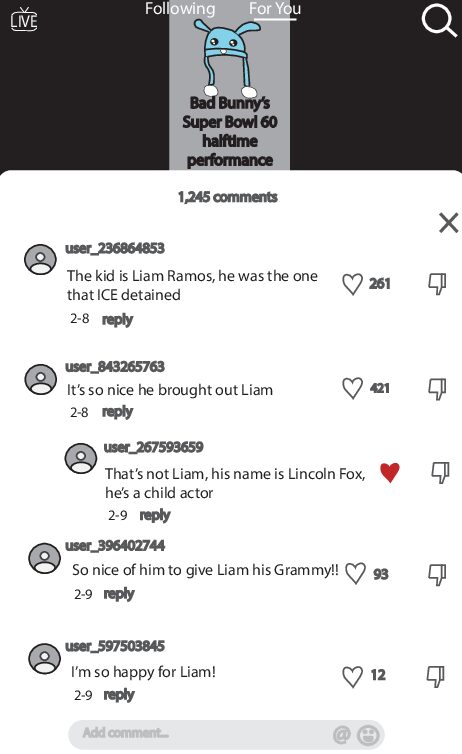
The most recent mainstream example of this is when Bad Bunny hosted the Superbowl last month. During his performance, he staged a moment when he brought out a little boy and handed that boy his Grammy award. When I went on tiktok afterwards, so many comments were posted claiming that the little boy was Liam Conejo Ramos, the 5 year old who was detained by ICE in January. This was just not true at all and there was absolutely no correlation between the two.
While this incident doesn’t seem inherently bad, it only showcases how quickly false information can spread with hundreds of videos and comments being made that night with a multitude of people claiming incorrect statements.
“Social media platforms allow users to instantaneously publish on virtually any topic, regardless of their qualifications or information accuracy. Platforms enable rapid sharing of content, and misinformation can ‘go viral’, cause harm and change beliefs before it can be effectively corrected,” according to the Health Promotion International journal.
The amount of misinformation being spread is rapidly increasing and in the current political state of the country with most people nowadays getting their news from social media, it can only harm and not help. It’s especially harmful since people switch up so quickly on social media after viewing just one video on a topic. They don’t bother to check the qualifications or find evidence about what a person is claiming and just blindly follow it.
It’s very abundant in the pop culture side of Tiktok. An example of this is when some famous influencer couple breaks up and multiple videos come out from a third party claiming person A did this or person B did that when in reality it’s all taken out of context or straight up lies.
Or whenever there is a big scandal occurring in the media with celebrities and influencers, users on Tiktok bandwagon to whoever’s side of the story is told first and they’re assumed to be in the right who is telling the truth.
The most popular example of this is the Olivia Rodrigo and Sabrina Carpenter fiasco that happened around five years ago, with Rodrigo releasing her album about her first breakup and her ex moving on quickly to another girl. Everyone on tiktok then found out the new girl was probably Carpenter and then sent mass amounts of hate, including death threats, toward her when they didn’t even know the whole situation.
It feels like now more than ever with the US government’s actions being constantly under the news with the release of Epstein files, ICE enforcement and the president’s actions with Iran causing people from all over to put their two cents in.
Especially with the Epstein files since we still don’t know a lot about them except names, names of people who may just be featured in the emails as a reference and actually have no correlation with Epstein like host Jon Stewert. But even so, multiple videos have been posted about the files and the people listed in them, gaining millions of views when there’s just not enough information yet out.
I do think Tiktok does an excellent job of having videos that catch one’s attention immediately and have that shock value to them, but it’s important to remember not to believe everything online and to always fact check before taking it to heart and sending it to others.