Designer: Samuel Cahuao
Nostalgia is an extremely conflicting feeling for people. It can be sweet and sentimental and takes people back to moments in their lives that may have been simpler or more joyful. Many people say that it’s a bittersweet feeling, nothing more than that. However, could too much nostalgia be bad for individuals?
We, as a staff, believe that overly romanticizing the past too much can turn into a false interpretation of it, and relying heavily on that creates negative outcomes.
False nostalgia is essentially an idealized longing for a past period that either never happened, was never personally experienced or is distorted by romanticized memory, according to Psychology Today.
This specific concept of nostalgia has been especially affected by social media and filtered algorithms. Documenting one’s experiences through social media and photos takes them out of the moment, which may hurt people’s memories, according to the National Institutes of Health.
Platforms encourage users to share only their happiest, most aesthetic moments, transforming the actual past into an edited post that ignores the negative things that happened.
This need to document just the positive events creates a lack of authenticity, also known as memory compression. According to its definition, compression naturally favors distinct peaks of joy, accomplishment or comfort. As a staff, we believe this creates a false sense of memory, creating an overly romanticized version of one’s history.
People also tend to overly romanticize due to present stress according to the National Institutes of Health. For example, if one was to feel lonely in the present time, they’d most likely crave a time when they had more friends. However, this could be distorted because of the need to find comfort from the past. The present and future can be chaotic and unknown, and the brain naturally craves predictability, making the past easier for people to rely on.
False nostalgia can also fix the brain backward. This mindset convinces individuals that the “best days” have already passed, which kills the motivation to set new goals, learn new skills or pursue personal development.
Visual and media artist Svetlana Boym argues in her book that restorative nostalgia is dangerous because it does not treat the past as a memory but as an absolute truth. This manifests as a total rejection of the present, trapping individuals into a close-minded perspective.
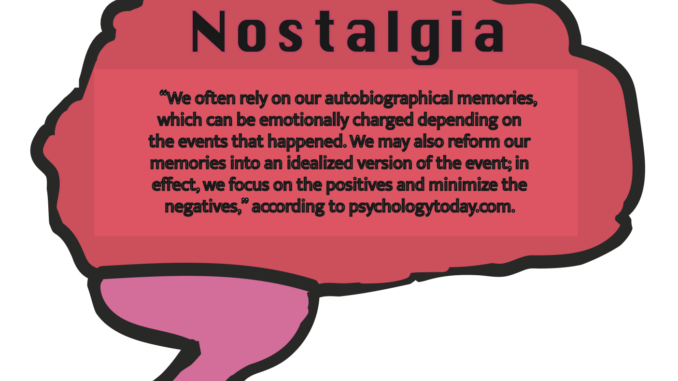
The brain naturally edits memories by dropping painful details and amplifying positive highlights according to the National Institutes of Health. This is another reason why recalling memories from the past that feel nostalgic can seem much more simpler and happier than the reality of what they were.
Media and television can also play a role in false nostalgia, coming-of-age films, retro music and media from decades like the 1980s and 1990s let people emotionally project themselves into unexperienced pasts. As a staff, we think this can take away from the negative events that also happened in those decades, leaving people to long for a time they have never experienced.
Social media also packages complex historical decades into specific aesthetics. Consuming these visual styles creates an emotional longing for the fictionalized lifestyle attached to them.
False nostalgia can also be an effect of simply wanting to relate to people. According to research, documented in Frontiers of Psychology, outlines how when groups discuss a shared text or past, their different individual recollections organically converge into a single, uniform story. This creates a collective memory based on peers, and not individually remembering organically.
False nostalgia has become more of an issue as years progress. While brief moments of nostalgia can be comforting, living in a fictionalized history carries distinct risks for one’s wellbeing and mindset.